INDUSTRY.co.id - The company's ambition to invest in Kendal Industrial Park (KIK) continues to increase along with the development of infrastructure conducted by PT Kawasan Industri Jababeka Tbk (Jababeka).
In addition, the Minimum Regional Wage (UMR) in Kendal is lower than in Jabode-tabek area become a special consideration for investors.
The Ministry of Industry noted, the creation of foreign exchange by the footwear industry amounted to USD 4.11 billion or 2.33 percent of the total national exports in 2014.
In terms of employment, the industry contributes 643 thousand jobs, equivalent to 4.21 percent of the manufacturing workforce.
The government continues to spur the footwear industry that is capable of absorbing mass labor. The development of this industry is also to boost export and market share of shoes of homeland products in the global market.
Indonesia's footwear market share in the world market of 2.85% in 2014 and ranked 6th after China, Italy, Vietnam, Germany and Belgium. This shows, the footwear industry has a chance to continue to increase exports.
So far, Indonesia is in the six largest footwear exporting countries in the world and therefore this sector is an important asset for Indonesia's manufacturing industry (generating foreign exchange and providing jobs for many people).
Major global players, such as Nike Inc. and some companies from China and South Korea, have production facilities in Indonesia because of the low labor cost in the country.
However, minimum wages have risen rapidly in recent years, undermining investment attractiveness in the shoe industry.
Another problem is that Indonesia needs to import some raw materials (leather and rubber) for shoe production. Despite being a major rubber producer, Indonesia still needs to import rubber materials for shoe production because it does not have adequate domestic processing facilities.
Regional Minimum Wage (UMR) Jabodetabek area continues to rise, makes the shoe and footwear industry glanced factory relocation plans. However, the factory relocation process was not as easy as turning the palm of the hand.
As has been complained by the Chairman of the Indonesian Footwear Association (Aprisindo), Eddy Wijanar-ko. He said the production of shoes that ogled is the area in Central Java or East Java.
For example Kendal, Jepara, Temanggung or Pasuruan. Answering that hope, Minister of Industry Saleh Husin said the government will spur the footwear industry because it is able to absorb a lot of labor.
Moreover, this sector can also boost exports. "The government wants a labor-intensive industry that employs a large workforce to grow," he said.
Chairman of the Indonesian Shoes Business Development Association (Aprisindo) Marga Singgih, the scanner of a sports shoe factory was conducted to avoid the demand for higher wages in Jabodetabek
According to him, the sports shoe factory is a labor-intensive factory that needs a lot of manpower, even up to 5,000 people.
However, shifting the shoe factory was not an easy matter. Therefore, the company must prepare the land and factory infrastructure, including the recruitment of new workers.
At least it takes 2 years-3 years for the transfer process, because it must move the machine and find new land.
With the district / city minimum wage (UMK in DKI Jakarta and West Java high pushing the industry players to force a number of entrepreneurs to leave the two provinces and seek new business areas in Central Java and East Java.
Former Chairman Apindo Sofyan Wanandi once details, there are already about 40 percent of companies looking for land in Central Java to relocate their factories. The company, among others, produces garments, textiles and shoes.
Of the approximately 40 companies, 10 companies from India and Korea have also relocated the plant.
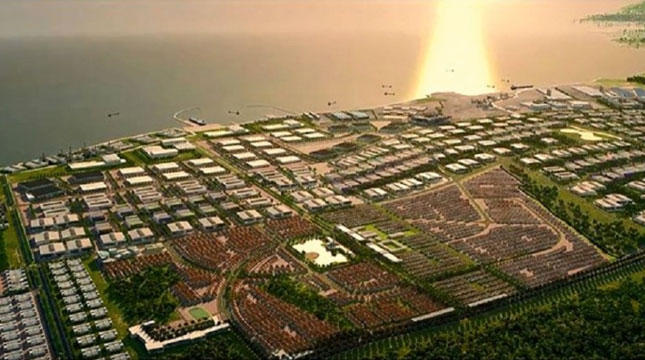
One of the fast moving business actors sees this problem is PT Kawasan Industri Jababeka by launching Kendal Industrial Park (KIK) which is ready to be marketed to entrepreneurs who will relocate the factory.
The Founder of PT Jababeka Tbk, Setyono Djuandi Darmono said, Kendal has its own investment attractiveness. Because the concept of KIK development is made like Jababeka Industrial Park in Cikarang, West Java. Not only become an integrated Industrial Park, but also an independent city.
However, of course still consider and adjusted to the potential of Kendal District itself. So far a number of companies engaged in textiles, electronics and consumer good have expressed interest in investing in Kendal Industrial Park.
Jababeka is committed to continue to build infrastructure & pre-facilities in the Industrial Park. Jababeka is a developer of KIK Kendal with a land concession of 2,200 hectares (ha).
Since September 2015, the Company has successfully acquired 433 ha of land and is committed to continue to increase its land bank in the region. In the development of KIK, Jababeka cooperated with Sembcorp Development Ltd as a partner.
The Singaporean company holds 49 KIK shares, while the majority of them are 51% owned by Jababeka