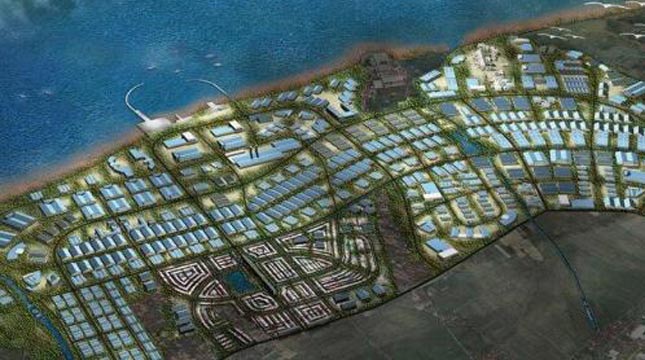
INDUSTRY.co.id - Ideally, all industrial activities are centered within an industrial estate. The reason, industrial area by definition in government regulation number 142 year 2015 about industrial area, is area where concentration of industrial activity equipped with supporting facilities and infrastructure developed and managed by company of Industrial Estate.
With the availability of infrastructure and facilities within Industrial Estate, investors no longer need to bear the cost of infrastructure development and the government will more easily prepare the planning of electricity supply, gas, raw water and other industrial infrastructure needs because the industry grows in one unity within a region.
It is a fact, the presence of Industry in Industrial Area will help the government in setting the industry's growth in the overlay, so the industry is growing in a regular arrangement with good and not sporadic, through the Industrial Area master plan that was approved by the government in each area of operation.
Currently, only about 40% of industries operate within the area, while the remainders still operate outside the industrial estate. We continually strive to increase the number of incoming industry department, said Imam Haryono Director General for Development of the Ministry of Industry to Industry.co.id Industrial zoning, on the sidelines of the Association of Industrial Area Conservation Stewardship (IPR) at the Grand Melia, Jakarta, Thursday (17 / 11) then.
According to him, by operating within the region, the industry will be able to improve efficiency, productivity and feel the ease of providing infrastructure, and this is also in accordance with the mandate of the Law on Perindusterian.
Many advantages gained in the region, such as tax and customs incentives, security, permits and many others. And this is within (Act) No. 3 of 2014 on Industry, which requires all industrial activities to be conducted within the region, he said.
In line with the Imam, Sanny Iskandar, who for the second time was confirmed as Chairman of the IPR period 2016-2020 (previously from 2012 to 2016-Red) also said that the IPR continues to encourage and disseminate government regulation that requires the industry is in an industrial area.
HKI took part in the development of industrial estate. We continue to invite new industries to be located in industrial areas, socialize the benefits of activities within the region, and also encourage the ease of investment in industrial areas, he said.
According to Sanny, various benefits come within the region, such as the arrangement of spatial and regional plans will be better, facilitate government oversight, especially against environmental pollution by industry players, and integration of supporting infrastructure in the industry.
In front of 63 members of the new board of IPRs period 2016-2020, Sanny invites all area managers, mainly members of the IPR which now consists of 73 members (industrial area managers) are scattered in various parts of Indonesia with a total area of 54 thousand hectares in the whole of Indonesia to continue to innovate And apply the standardization of the area so that prospective tenants willing and happy to move their business into the region.
We as regional managers must improve the standard of services and professional management, supporting facilities and infrastructure that are in accordance with the standards, and good environmental management. This is important, so that investors benefit and are interested in joining in the industrial area, he pleaded.
Sanny said, there are still many industrial areas that are not managed in accordance with the aspect of standardization of industrial estates.
Industrial areas are responsible, some are not. This is the portrait and face of the whole area, if one is bad then the other will get hit. Therefore, it is important for us to immediately standardize the area. This standard includes three aspects that must be met well, namely management and service, industrial and environmental infrastructure, he concluded.
As a strategic partner of the Government, in addition to socializing the industrial program entry area, HKI also continue to provide input to the Government to encourage the growth of industrial parks in various regions, outside the main Java. This is important, so that the equity of industrial growth can be created and not concentrated in Java.
Currently concentrations are still in Java, about 76% versus 24% outside Java. We continue to encourage the growth of industrial parks evenly in various regions, said Sanny.
To note, Across Indonesia, there are currently 232 industrial estates with a total area of about 78,976 ha. Of that total, 110 industrial estates are located in the western part of Java Island, 19 in Central Java, 32 in East Java, and the rest are spread out of Java.
HKI noted, there are 27,000 hectares of land that functioned as an industrial area in Indonesia, but has not developed optimally. Of that number, the largest area is in West Java reaching 13.03 thousand ha with industrial buildings only 5,582 ha. Of the 73 industrial areas of HKI members, the area of land that has been built has reached 23.3 thousand ha, most of which (18.7 thousand ha) are located in Java.
Three-way money with the chairman, Vice Chairman of Regional Development & Relationship of Hygiene Wihadhi, who is also Director of Kendal Industrial Estate (KIK), said that demand for industrial land continues to increase in line with Indonesia's economic performance.
In the next five years, Indonesia needs at least 10 thousand hectares (ha) of land for new industrial estates, he said.
Every year, the need for industrial land in Indonesia reaches 1,200 ha. In the next five years, 60% of total demand for land is still concentrated in Java Island and the remaining 40% spread outside Java Island.
According to Hyanto, the trend of new land demand for industrial areas in Indonesia will begin to shift out of Java next year. Due to the high demand, it also hopes that the developers can continue to be given ease in obtaining land in an effort to develop new industrial areas in particular.
"In 2017, demand for industrial land will shift beyond Java, as a result of industry downstream and government regulation on equitable distribution across the region in Indonesia," he continued. "We continue to expect incentives, ease of land permits and security protection," he concluded.
Development of Area From Time to Time
If traced to the development of industrial estates since the early period of 19709, this sector is actually started by a number of government-owned companies and local governments. Industrial Estate Development in that period started with the study of Industrial Area Development Plan in Cilacap Central Java area in 1969.
Physically, the development of Industrial Zone started in Jakarta, with the construction of Pulogadung Industrial Estate (Industrial Estate Pulogadung) of 500 Ha in 1970. Pulogadung Industrial Estate is a half-owned enterprise owned by the Central Government in this case the Ministry of Finance, while half of the shares Other owned by DKI Jakarta Government.
Next are built seven industrial estates owned by the central government and local governments plus an industrial area being worked on. Call it PT Surabaya Industrial Estate Rungkut in Surabaya, then PT Kawasan Industri Cilacap, PT Kawasan Industri Medan, PT Berikat Nusantara Area in Jakarta and PT Krakatau Industrial Estate Cilegon in Banten. Currently the Government of Lampung Province is working to develop an industrial estate on the Register I Waypisang, Ketapang, South Lampung regency.
In addition to eight industrial estates that have been developed by local governments, about 200 industrial estates are built on private initiatives. The development of industrial estates by the private sector began to bloom in the period 1989 2009, starting with the issuance of Presidential Decree No. 53 of 1989 on Industrial Zones, which opened the opportunity to the private sector to develop Industrial Zones.
It is PT Kawasan Industri Jababeka Tbk (KIJA) which became the pioneer of publication of the first private industrial area in Indonesia in 1989 and in the mentioned period, also touted as the era of the rise of Industrial Zone in Indonesia because quite a lot of industrial area which started to be developed since 1989-2009.
And in the draft of the National Industrial Development Master Plan (RIPIN), up to 2035, the Government is targeting an additional 36 new industrial estates scattered throughout Indonesia.
Until 2019, 15 new industrial estates are targeted for completion. Where, as many as 13 industrial areas outside Java and the rest on the island of Java, the 13 locations of this industrial estate are in Bantaeng South Sulawesi, Bitung North Sulawesi, Konawe Southeast Sulawesi, Ketapang-West Kalimantan, Licin-South Kalimantan, Landak-West Kalimantan, Kuala Tanjung and Sei-Mangke North Sumatra, also in Tanggamus- Lampung. Palu, Morowali, Buli-Halmahera and Bintuni West Papua.
Meanwhile on the island of Java is in Gresik and Sayung-Demak. And recently the Government has successfully executed one of its targets, namely the establishment of Kendal Industrial Estate (KIK), a region made by PT Jababeka Tbk with SembCorp of 803 ha (phase1) of total area of 2700 ha. The inauguration was conducted by President Joko Widodo with the Prime Minister (PM) of Singapore.