INDUSTRY.co.id - Jakarta - Starting in October 2017 the Ministry of Public Works and Public Housing (PUPR) applies the use of electronic money on all transactions on toll roads and no longer payments in cash.
PUPR Minister Basuki Hadimuljono said on Wednesday (9/8/2017) that since the government's plan on electronics toll road has been announced, through public campaigns the use of new electronic money has risen to 33% during Idul Fitri season and discount program for electronic money users. "Currently, new electronic money users reach 28%," said Basuki.
The government plans to implement Multi Lane Free Flow (MLFF) or non-stop toll payments (toll road users do not have to stop vehicles at toll booths) by December 2018. To reach the MLFF stage, it will go through three stages, namely in the early stages will be the use of electronic money On all transactions on the highway in October 2017.
Then continued toll road integration and toll road integration with the Electronic Toll Collection consortium in December 2017.
Prior to starting a 100 percent non-cash transaction program, Toll Road Regulatory Agency (BPJT) with BUJT and banks has conducted various campaigns, both at national and local levels, multi-vendor and non-exclusive transaction implementation, expansion of Automated Toll Gate (GTO), location extension Top-up, and preparation of non-cash toll transaction regulation.
"This campaign needs to be intensified until mid-September next year, for our next evaluation," said Basuki.
The gradual integration of tolls will also be undertaken. The Jakarta-Tangerang-Merak Toll Road has been integrated since May 2017. The Jakarta-Bogor-Ciawi (Jagorawi) and Jakarta Outer Ring Road (JORR) integration is in preparation for integration.
As for the integration of Cluster 1 and Soreang - Pasir Koja, the integration of Jagorawi and Ciawi-Sukabumi, the integration of Semarang City and Surabaya City, is still in the early discussion phase. Integration will also be made at the Electronic Toll Collection (ETC) consortium to enable more efficient non-cash toll transactions.
Meanwhile, BI Governor Agus Martowardoyo welcomed the cooperation. "We welcome the coordination to be evaluated, in addition to the Ministry of PUPR and BI, there are two main stakeholders, namely BUJT and banking, and we are continuously coordinating for October 2017, the transaction on toll roads runs non-performing," said Agus.
According to him, discount campaigns and special offers to increase interest in toll road users will also continue. The number of electronic money users on toll roads is expected to increase significantly in the next 1.5 months.
Regarding regulatory strengthening, the Minister of PUPR will issue a Ministerial Regulation (Permen PUPR) as the legal basis for the transfer of cash to non-cash payments targeted to be issued before August 17, 2017. BI will also convince banks that the toll road transaction system will work.
Start in October 2017, the Ministry of Public Works and Public Housing Implemented the Use of Electronic Money on All Toll Transactions
Starting in October 2017 the Ministry of Public Works and Public Housing (PUPR) applies the use of electronic money on all transactions on toll roads and no longer payments in cash.
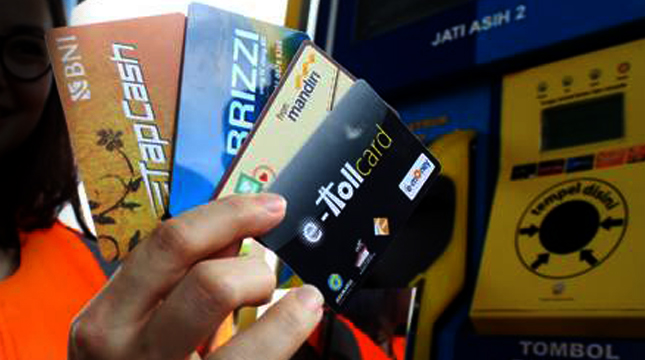
e-Toll Card
Tags: