
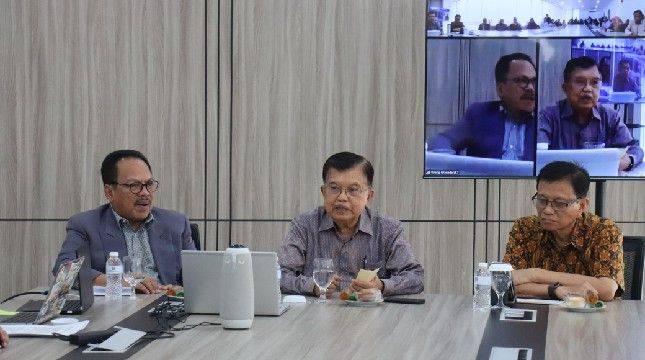
INDUSTRY.co.id - Jakarta – The Doctoral Study Program in Management Science of Paramadina University held a Hybrid Public Seminar entitled "Economic Policy and Crisis Management" on Tuesday (6/9/2026) in the Granada Room, 7th Floor of the Nurcholish Madjid Building, Paramadina Cipayung University. The seminar presented the 10th and 12th Vice Presidents of the Republic of Indonesia, H. M. Jusuf Kalla, as the main speaker.
The activity was opened by the Head of the Management Science Doctoral Study Program at Paramadina University, Prof. Dr. Ahmad Badawi Saluy, and moderated by the Rector of Paramadina University, Prof. Dr. Didik J. Rachbini.
In his presentation, Jusuf Kalla asserted that Indonesia's history shows a close relationship between the economic crisis and political change. According to him, economic turmoil that is not handled properly often develops into a political crisis that has a major impact on national stability. “The economic crisis has always had something to do with politics. Bung Karno fell due to the economic crisis which later developed into a political crisis. Rice prices rose, BBM rose, people demonstrated, and various political upheavals emerged. Pak Harto also did so during the 1998 crisis until he finally fell after leading for 32 years," said Jusuf Kalla.
He explained that one of the important indicators that needed to be considered in anticipating the crisis was the condition of the rupiah exchange rate. According to him, the value of the currency is largely determined by the level of public confidence in the national economy. "The currency is about supply and demand. Many people save the United States dollar because they don't believe in the rupiah. The more people save dollars, the lower the value of the rupiah will be," he said.
In addition to exchange rates, Jusuf Kalla also highlighted the importance of understanding market conditions more comprehensively. He reminded that economic conditions cannot be measured only by the number of shopping centers. "There are two markets, namely the capital market and the real market. People often say malls are still crowded so the economy is considered fine. Even though people come to the mall not necessarily to shop, they can just find a comfortable place or AC. What must be seen is how the purchasing power of the community in the real market," he explained.
According to Jusuf Kalla, the current weakening of the capital market also indicates a problem of investor confidence. Investors will only invest if they have confidence that the company is able to generate sustainable profits. “The capital market is down due to trust issues. People buy stocks because they believe the company will make a profit. When confidence declines, stocksare released. In the past, mining stocks were in great demand, now many are experiencing a decline. Banking stocks are also under pressure so many investors have taken off their holdings," he said.
Furthermore, he reminded that economic pressure often raises various social problems in society. According to him, the increasing crime rate cannot be separated from the deteriorating economic conditions. "When many people are unemployed and have difficulty making ends meet, various social problems will arise. We see cases of theft and street crime that are talked about. This must be a common concern because economic and social conditions are interrelated," he said.
On this occasion, Jusuf Kalla emphasized the importance of the role of universities in helping to find solutions to various economic problems faced by the nation. According to him, universities have a responsibility not only in education, but also in producing research that can be the basis for the formulation of public policy. "The first task of the university is to educate the nation. Second, make a contribution to the community and government through research results. The campus must be able to present solutions to various problems faced by the community," he said.
He also considered that academics need to continue to voice critical and data-based views in responding to various public policies. In this context, Jusuf Kalla appreciates the role of Paramadina University which actively provides views and studies on various national issues.
In the fiscal sector, Jusuf Kalla emphasized the importance of state budget efficiency. According to him, the government needs to immediately evaluate various expenditures that do not have a direct productive impact on economic growth. "Unproductive expenditures must be reduced. Don't take too long. Just make a decision on which burdens to cut and reduce so that the country's fiscal becomes healthier," he said.
Jusuf Kalla also reminded that Indonesia will face a number of major challenges in the next few years. One of them is the threat of El Nino which has the potential to reduce national food production. "If El Nino lasts for seven months, rice production can decrease. We have to import food and of course it requires large funds. This must be anticipated from now on," he said.
In addition, he highlighted the potential electricity crisis due to the lack of energy infrastructure development in recent years, as well as the increasing burden of subsidies that can further burden state finances if not balanced with the right policies.
Closing his presentation, Jusuf Kalla explained that the current state of the national economy is influenced by three main factors. First, the impact of global conflicts such as the war in the Middle East and theRussia-Ukraine conflict that triggered the world energy crisis. Second, the high burden of state debt causes interest payment obligations to continue to increase. Third, the importance of effective crisis management through controlling budget deficits and reducing unproductive spending. "Crisis management must be done by reducing debt through controlling the APBN deficit. All unproductive expenditures need to be reduced or eliminated so that the economy can be healthier and more sustainable," he concluded.


