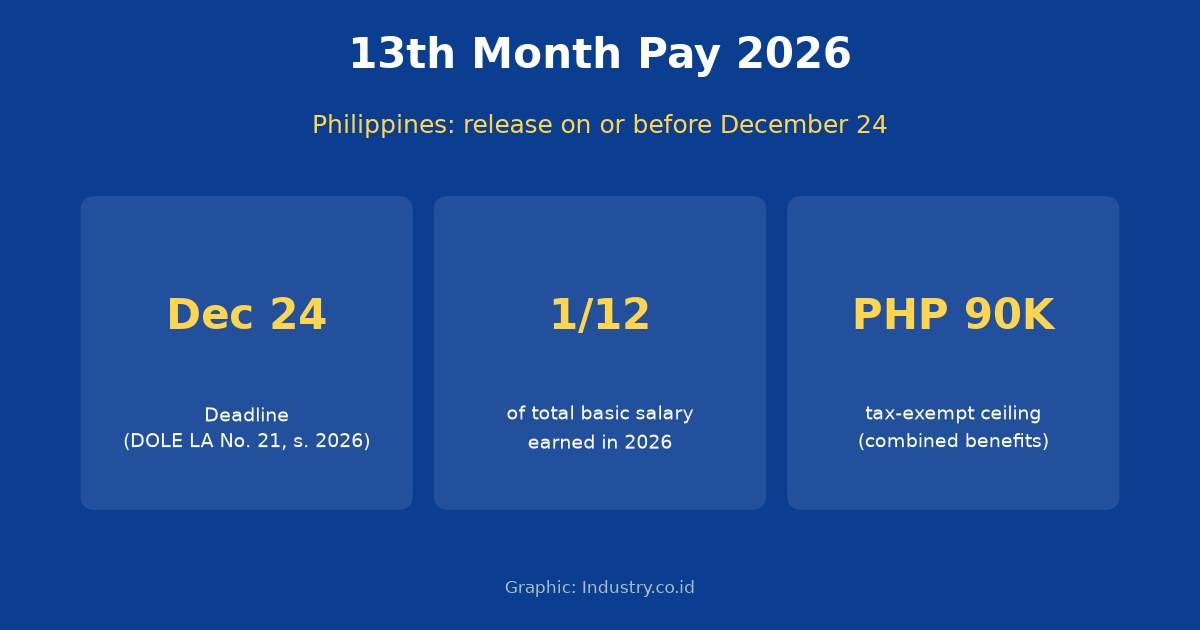
- DOLE Labor Advisory No. 21, Series of 2026, requires private employers to release 13th month pay on or before December 24, 2026.
- All rank-and-file private sector employees who worked at least one month in 2026 are entitled, regardless of employment status or pay method.
- The minimum amount is one-twelfth of the total basic salary earned during the calendar year.
- Employees who resigned or were terminated before December still get a prorated 13th month pay.
- Under the TRAIN law, 13th month pay and other benefits are tax-exempt up to a combined PHP 90,000 per year.
13th month pay 2026 is due soon. The Department of Labor and Employment (DOLE) has reminded private employers in the Philippines that the benefit must be paid on or before December 24, 2026, and that the rule covers every rank-and-file worker who has worked at least one month this year.
The reminder comes through Labor Advisory No. 21, Series of 2026, signed by Labor Secretary Francis N. Tolentino and reported on November 10, 2026. It is based on Presidential Decree No. 851, the law that created the 13th month pay in 1975.
For millions of Filipino workers, the 13th month pay is the biggest extra money of the year. Knowing how much you should receive, and when, helps you plan Christmas spending, pay debts, or start savings before 2027.
Quick answer: In the Philippines, 13th month pay must be paid on or before December 24, 2026. It equals at least one-twelfth of the total basic salary you earned in 2026. Every rank-and-file private employee who worked at least one month in the year is entitled, including resigned workers on a prorated basis.What Is 13th Month Pay?
The 13th month pay is a mandatory benefit under PD 851. It is not a bonus that employers can choose to give or withhold. If you are a rank-and-file employee in the private sector and you worked at least one month during the calendar year, your employer must pay it.
DOLE says the benefit applies regardless of employment status, position, or method of wage payment. That covers regular, probationary, and contractual staff, as well as piece-rate workers, employees paid a fixed wage plus commission, and people who work for more than one employer.
Managerial employees, meaning those with the power to hire, fire, or discipline staff, are generally not covered by PD 851, although many companies still give them a similar benefit. Government employees receive a separate year-end bonus under rules for the public sector.
How to Compute Your 13th Month Pay
The formula is simple: add up the basic salary you actually earned from January to December, then divide by 12.
Basic salary usually means your regular pay for work done. Overtime pay, holiday and premium pay, night shift differential, and most allowances are normally not included unless your company treats them as part of basic pay. DOLE notes that commissions are excluded if they are not part of the basic salary. Unpaid leave days reduce the total because no basic salary was earned on those days.
| Situation | Total basic salary in 2026 | 13th month pay |
|---|---|---|
| PHP 20,000 per month, full year | PHP 240,000 | PHP 20,000 |
| PHP 18,000 per month, 3 days unpaid leave | PHP 213,517 (daily rate based on 261 working days) | PHP 17,793 |
| Hired July 1 at PHP 25,000 per month | PHP 150,000 | PHP 12,500 |
| Resigned after March at PHP 30,000 per month | PHP 90,000 | PHP 7,500 |
Examples are simplified. Your actual figure depends on the basic salary your employer recorded for the year.
A quick way to check your payslip is to look at your monthly basic pay. If you worked the whole year with no unpaid leave and no salary change, your 13th month pay should equal one month of basic salary.
Resigned, New or Part-Time Workers
You do not need to be employed on December 24 to receive 13th month pay. DOLE says employees who resigned or were terminated before the deadline are entitled to a proportionate amount based on the basic salary they actually earned during the year. This is often released together with the final pay.
New hires get a prorated amount too, as long as they worked at least one month in 2026. Part-time workers and employees on maternity leave who received salary differentials are also covered under the advisory.
Some employers pay part of the benefit earlier, for example in the middle of the year, and the balance in December. What matters is that the full amount reaches the worker by December 24.
Is 13th Month Pay Taxed?
Under the TRAIN law (Republic Act 10963), 13th month pay and other benefits such as a Christmas bonus or productivity incentives are exempt from income tax up to a combined PHP 90,000 per year. Only the part above that ceiling is taxed.
For most rank-and-file workers, the 13th month pay is well under PHP 90,000, so it arrives tax-free. Workers with high salaries or large bonuses should check their payslip, because the ceiling counts all those benefits together.
| Item | Rule |
|---|---|
| Deadline | On or before December 24, 2026 |
| Minimum amount | Total basic salary earned in 2026 divided by 12 |
| Who is covered | Rank-and-file private employees with at least one month of work |
| Tax-exempt ceiling | PHP 90,000 combined with other benefits |
| Legal basis | PD 851 and DOLE Labor Advisory No. 21, s. 2026 |
What to Do If Your Employer Does Not Pay
Start by asking HR for a computation of your 13th month pay. Payroll errors are common, especially when salary changed during the year.
If the benefit is still not paid after December 24, you can contact the nearest DOLE regional or field office. DOLE says its regional, field, and provincial offices monitor compliance under Department Order No. 238, Series of 2023. Keep copies of your payslips and employment contract as evidence.
Once the money arrives, consider setting aside part of it before the holiday rush. Paying high-interest debt, building an emergency fund, or putting money in a savings account can make the benefit last well into 2027.
FAQ (Frequently Asked Questions)
Private employers in the Philippines must release 13th month pay on or before December 24, 2026, according to DOLE Labor Advisory No. 21, Series of 2026. Add the basic salary you earned from January to December 2026 and divide it by 12. Overtime, holiday pay and most allowances are usually not included. Yes. Employees who resigned or were terminated before December are entitled to a prorated 13th month pay based on the basic salary they earned during the year. It is tax-exempt up to PHP 90,000 per year, combined with other benefits such as bonuses, under the TRAIN law. Only the excess is taxed. No. It is mandatory under PD 851 for rank-and-file private employees, and DOLE monitors compliance through its regional offices.1. When is the 13th month pay deadline in 2026?
2. How do I compute my 13th month pay?
3. Do resigned employees get 13th month pay?
4. Is 13th month pay taxable?
5. Can my employer skip 13th month pay this year?
Conclusion
The 13th month pay is a legal right, not a favor. Check that your employer releases it by December 24, 2026, verify the amount against your basic salary, and contact DOLE if something is wrong.
- Deadline: December 24, 2026.
- Formula: total basic salary / 12.
- Covers all rank-and-file private employees with at least one month of work.
- Resigned workers get a prorated amount.
- Tax-free up to PHP 90,000 combined with other benefits.