
INDUSTRY.co.id - Surabaya - A total of 27,500 tons of imported salt from Australia to arrive at Tanjung Perak Port Surabaya will be distributed to several Small and Medium Industries (IKM) in three provinces, East Java, Central Java and West Kalimantan.
Director of Finance of PT Garam, Anang Abdul Qoyyum, said in Surabaya on Friday (11/8/2017) that the plan to ship MV Golden Kiku on Friday at 18.00 WIB will arrive at the Port of Tanjung Perak Surabaya and bring imported salt of 27,500 Ton.
"The imported salt that we dropped in Surabaya will target SMEs in East Java and Central Java, plus some IKM in West Kalimantan, which will be processed and sold on the market," he told media crews.
He hopes that by importing salt from Australia through the Port of Tanjung Perak, will gradually reduce the price of salt in the market, especially the local area around Rp4.500 to Rp5.000.
Anang admitted that PT Garam is currently verifying a number of existing IKMs in the three areas, aiming to avoid any abusive SMEs receiving imported Australian salt.
Meanwhile, the salt arriving at Tanjung Perak Port will be lowered and stored first in the warehouse of PT Garam in Surabaya area, then it will be distributed gradually.
Previously, the arrival of imported salt to Indonesia is divided into three stages, namely the first stage on Thursday (10/8) early morning using the MV Ship. Eco Destiny at Ciwandan Port of Banten, carrying 25,000 tons of cargoes, and spread to Central Java, West Java and Jakarta.
The second arrival using the Golden Kiku MV Ship on August 11, 2017 at 18:00 pm at the Port of Tanjung Perak Surabaya with 27,500 tons of salt.
Furthermore, the third arrival using the MV Union Challenge and scheduled to arrive on 21 August 2017 at Belawan Port, Medan with 22,500 tons of salt, and spread to a number of SMEs in the region of Sumatra and surrounding areas.
Arrival of imported salt from Australia is a commitment of PT Garam in carrying out the assignment from the government, with total imports of raw material salt for consumption of 75,000 tons and 97 percent NaCl content.
Only for SMEs Sector, Three Provinces Provide 27,500 Ton Imported Salt
A total of 27,500 tons of imported salt from Australia to arrive at Tanjung Perak Port Surabaya will be distributed to several Small and Medium Industries (IKM) in three provinces, East Java, Central Java and West Kalimantan.
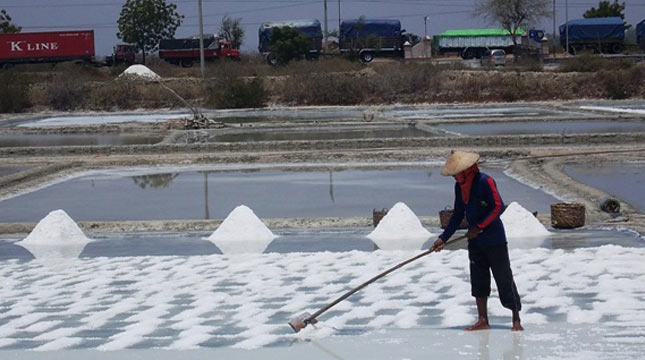
Salt Farmer
Tags: