INDUSTRY.co.id - Jababeka - As a form of corporate social concern, PT Jababeka Infrastructure continually strives to support environmental conservation, by actively participating in programs initiated by local and provincial governments.
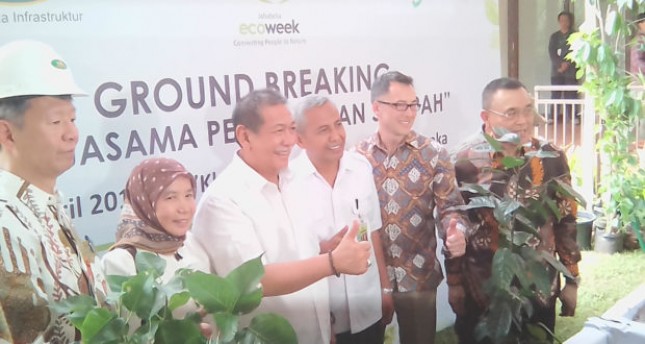
One form of environmental concern, PT Jababeka Infrastruktur held the 'Jababeka Ecoweek 2017' event and ground breaking of waste management cooperation into ethanol between PT Jababeka Infrastructure and Greenbelt Resources which took place at D'Khayangan Senior Living Jababeka, Sertajaya Village, East Cikarang Subdistrict, Regency Bekasi, Thursday (27/04) at around 10:00 pm completed.
The event was attended by Directorate General of River Flow and Protected Forest Sussylawati, Deputy Governor of West Java Dedi Mizwar, Head of West Java Province Environmental Management Agency, Director of Ministry of Environment, Local Government of Bekasi Regency, and Kasi Ter Korem 051 / Wijayakarta Lt Col Col Joko Triyanto and Major Yahya.
"West Java province only handles the regional ones. This rubbish affair is actually a district / city affair, we only help facilitate regional waste management. For Bandung Raya in Legok Nangka and it is still much to be applied," said Demiz greeting familiar Dedi Mizwar on the sidelines of the event.
In addition, continued Demiz, in Bogor Nambo and Depok areas are still a lot of problems about waste, the same as Bandung Raya. "So is Cirebon, and the problem is limited land. The garbage problem is now under the Environment. And we are trying to land in order to accommodate the waste and manage it, "he explained.
The breakthrough of PT Jababeka Infrastructure to manage organic waste is worth applying. The reason is that way can reduce the mounting of garbage, including inorganic waste can be utilized by being sorted and given to the garbage bank to be crafted.
Meanwhile, President Jababeka Infrastructure Tjahjadi Rahardja, in his press statement said the cooperation is also beneficial to Jababeka area that produces about 40 tons of waste in a day.
This cooperation can add value to waste. "The process of waste into ethanol is for the needs of the factory in Jababeka," said Tjahjadi.
In addition, the transfer of waste into compost can also be used for the needs of parks in industrial areas. "Our symposium is ideal," he said. He calculates that this solution can reduce the amount of waste that has been sent to the final landfill.


