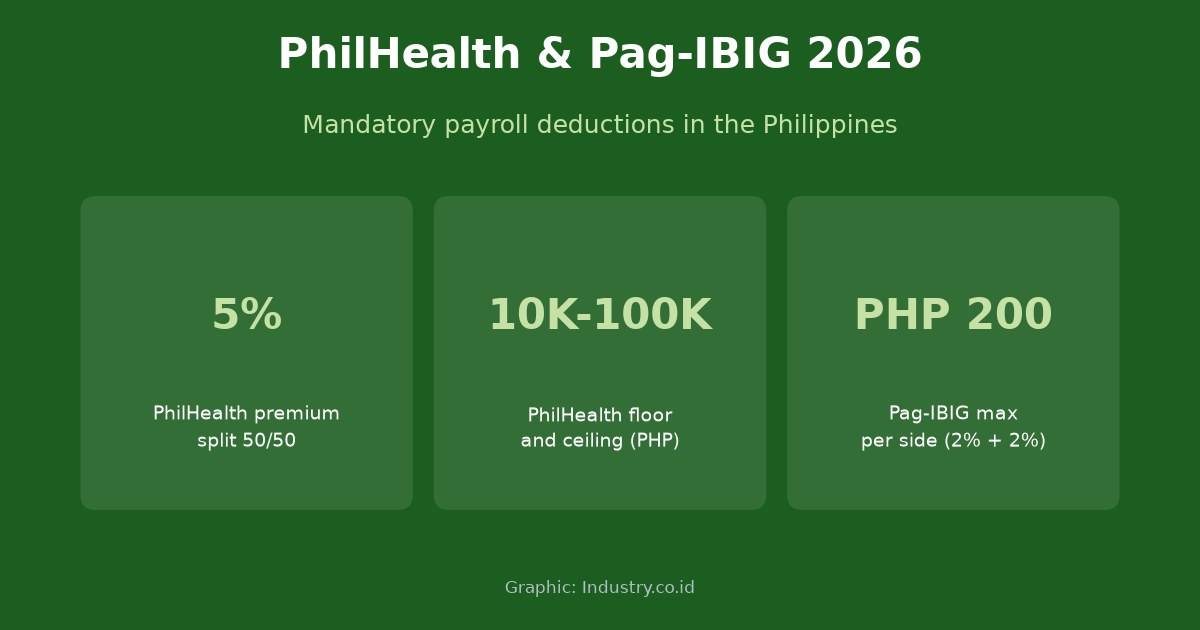
- PhilHealth's premium rate for 2026 is 5% of monthly basic salary, the same as in 2025.
- PhilHealth uses an income floor of PHP 10,000 and a ceiling of PHP 100,000, so premiums range from PHP 500 to PHP 5,000 a month.
- Employed members split the PhilHealth premium 50/50 with their employer.
- Pag-IBIG deducts 2% from employees earning above PHP 1,500 and the employer adds 2%, based on a maximum fund salary of PHP 10,000.
- The maximum Pag-IBIG contribution is PHP 200 from the employee and PHP 200 from the employer each month.
PhilHealth and Pag-IBIG contributions in 2026 are two of the three mandatory deductions on every Filipino payslip, alongside SSS. Neither rate changed this year, but many workers still are not sure how much should be taken from their salary.
PhilHealth, the national health insurer, funds hospital and outpatient benefits. Pag-IBIG, formally the Home Development Mutual Fund (HDMF), is a savings program that also gives members access to housing, multi-purpose and calamity loans.
This guide explains the 2026 rates, shows sample deductions at common salary levels, and adds up the total government deductions together with SSS so you can check your take-home pay.
Quick answer: In 2026, PhilHealth charges 5% of monthly basic salary, with a PHP 10,000 floor and PHP 100,000 ceiling, split equally between employee and employer. Pag-IBIG takes 2% from the employee and 2% from the employer on salary up to PHP 10,000, so each side pays a maximum of PHP 200 a month.PhilHealth Contribution 2026
Under the Universal Health Care Act (Republic Act 11223), PhilHealth premiums rose gradually until they reached 5% of monthly basic salary. That rate applies again in 2026, and no suspension or reduction appears in the list of PhilHealth circulars issued this year.
The premium is computed on monthly basic salary, with a floor of PHP 10,000 and a ceiling of PHP 100,000. Anyone earning PHP 10,000 or less pays the minimum premium of PHP 500 in total, and anyone earning PHP 100,000 or more pays the maximum of PHP 5,000. Employed members share the premium equally with their employer.
| Monthly basic salary | Total premium (5%) | Employee share | Employer share |
|---|---|---|---|
| PHP 10,000 or less | PHP 500 | PHP 250 | PHP 250 |
| PHP 15,000 | PHP 750 | PHP 375 | PHP 375 |
| PHP 20,000 | PHP 1,000 | PHP 500 | PHP 500 |
| PHP 25,000 | PHP 1,250 | PHP 625 | PHP 625 |
| PHP 50,000 | PHP 2,500 | PHP 1,250 | PHP 1,250 |
| PHP 100,000 or more | PHP 5,000 | PHP 2,500 | PHP 2,500 |
Self-employed, voluntary and OFW members pay the full 5% themselves, subject to the same floor and ceiling.
Pag-IBIG Contribution 2026
Pag-IBIG contributions are based on monthly compensation, but only up to a maximum fund salary of PHP 10,000. Employees earning PHP 1,500 or less contribute 1%, while those earning more contribute 2%. Employers contribute 2% in both cases.
Because of the PHP 10,000 cap, most formal workers pay a flat PHP 200 a month, matched by PHP 200 from the employer. Members who want to save more can voluntarily contribute above the mandatory amount, and that extra goes into the same Pag-IBIG savings.
| Monthly compensation | Employee | Employer | Total |
|---|---|---|---|
| PHP 1,200 | PHP 12 (1%) | PHP 24 (2%) | PHP 36 |
| PHP 5,000 | PHP 100 | PHP 100 | PHP 200 |
| PHP 8,000 | PHP 160 | PHP 160 | PHP 320 |
| PHP 10,000 and above | PHP 200 | PHP 200 | PHP 400 |
Rates as published by Philippine payroll guides in November 2026, citing HDMF Circular No. 460.
Total Government Deductions on a Sample Payslip
Adding SSS, PhilHealth and Pag-IBIG shows how much of your salary goes to mandatory contributions before income tax. The table uses 2026 rates for employed members.
| Monthly salary | SSS (employee) | PhilHealth (employee) | Pag-IBIG (employee) | Total employee deductions |
|---|---|---|---|---|
| PHP 15,000 | PHP 750 | PHP 375 | PHP 200 | PHP 1,325 |
| PHP 20,000 | PHP 1,000 | PHP 500 | PHP 200 | PHP 1,700 |
| PHP 25,000 | PHP 1,250 | PHP 625 | PHP 200 | PHP 2,075 |
| PHP 35,000 | PHP 1,750 | PHP 875 | PHP 200 | PHP 2,825 |
Salary is assumed to equal the SSS monthly salary credit bracket. Income tax is not included.
For a worker earning PHP 20,000, mandatory contributions take about 8.5% of gross pay. These deductions also lower taxable income, because SSS, PhilHealth and Pag-IBIG employee shares are excluded from taxable compensation.
How to Check That Your Contributions Are Paid
Deductions on your payslip only help you if your employer actually remits them. You can check your PhilHealth records through the PhilHealth member portal and your Pag-IBIG savings through the Virtual Pag-IBIG online account.
Missing contributions can block a housing loan, delay a hospital claim, or reduce future benefits. If you find gaps, ask HR for proof of remittance first, then report to the agency if the problem continues.
Self-paying PhilHealth members should also keep their payments current. Payroll guides note that PhilHealth now requires a Statement of Premium Account for self-paying members, so check the member portal before paying.
FAQ (Frequently Asked Questions)
PhilHealth charges 5% of monthly basic salary in 2026, with a PHP 10,000 floor and a PHP 100,000 ceiling. Employees pay half of the 5% premium, or 2.5% of monthly basic salary, from PHP 250 to PHP 2,500 a month. Employees earning above PHP 1,500 pay 2% and employers pay 2%, based on a maximum fund salary of PHP 10,000. The maximum is PHP 200 each. Yes. Members can make voluntary contributions above the mandatory amount to increase their Pag-IBIG savings. No. The employee shares of SSS, PhilHealth and Pag-IBIG are excluded from taxable compensation, which lowers your income tax.1. What is the PhilHealth contribution rate in 2026?
2. How much is the employee share of PhilHealth?
3. How much is the Pag-IBIG contribution in 2026?
4. Can I contribute more than PHP 200 to Pag-IBIG?
5. Are SSS, PhilHealth and Pag-IBIG deductions taxed?
Conclusion
PhilHealth and Pag-IBIG rates are unchanged in 2026. Use the sample tables to check your payslip, and confirm through each agency's online portal that your employer is remitting your contributions on time.
- PhilHealth: 5% of basic salary, split 50/50.
- PhilHealth floor and ceiling: PHP 10,000 to PHP 100,000.
- Pag-IBIG: 2% + 2%, capped at PHP 200 each.
- Total deductions at PHP 20,000 salary: about PHP 1,700.
- Check remittances online through the member portals.