INDUSTRY.co.id - Jakarta – The wave of artificial intelligence (Artificial Intelligence/AI) investment continues to strengthen in the Asia region -Pasifik (APAC).
Recent research from Accenture through the Pulse of Change report shows that 86 percent of company leaders in APAC are committed to significantly increasing investment in AI technology.
However, despite the high ambition of digital transformation, many companies still face fundamental obstacles, namely the quality and availability of operational data that is not optimal. The data needed to support AI is often still manually recorded, incomplete, and late to the system.
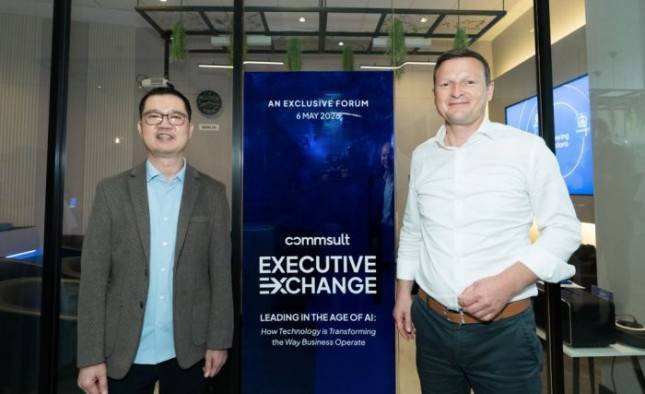
This issue became the main highlight of the commsult Executive Exchange event held in Jakarta on May 6, 2026. Carrying the theme "Leading in the Age of AI: How Technology is Transforming the Way Businesses Operate", the forum presented a number of large companies such as PT Bayer Indonesia, PT Astra Tol Nusantara, Garuda Yamato Steel, and Sinar Mas Land to discuss the challenges of AI implementation in business operations.
The founder and CEO commsult of AG, Michael Buschner, revealed that many companies still rely on manual recording processes in warehousing management.
According to him, the use of pen and paper to record warehouse activities makes the process slow and prone to errors. Data must be measured, sent, then entered back into a system such as SAP, so it takes a lot of time.
"We still find many companies that work with manual methods. As a result, the process becomes longer and the data needed for business analysis is not available quickly," he said.
In fact, AI requires accurate, complete, and real-time data in order to be able to produce the right analysis and recommendations. Without a strong data foundation, a large investment in AI risks not yielding maximum results.
In a fireside chat session, CIO Sinar Mas Land, Stefanus Mulianto, asserted that the success of digital transformation does not only depend on technology.
According to him, companies need to place people and business processes as top priorities before adopting new technologies.
"Man, process, technology. Don't turn it upside down. Change does not happen because of technology alone. Companies must have the right mindset, the right process, then use technology as a tool to solve problems," explained Stefanus.
A similar view was also conveyed by Heru Sutadi, a digital expert from ICT Institute. He considered that the use of AI in Indonesia's logistics operations began to develop even though it was still in its early stages.
"The biggest challenge today is integration with existing systems and the need for high-quality data. However, the trend of logistics digitization is encouraging more and more industry players to start trying AI-based solutions," said Heru.
Seeing the challenge, commsult introduced Ontego SAP Mobility, a mobile-based warehouse management platform that directly connects warehouse floor activities with the SAP system through tablets and smartphones.
The solution is designed to eliminate the time lag between operational activities and data logging in enterprise systems.
One of Ontego's main advantages is the real-time integration of data into SAP. Thus, the data entering the system reflects the actual conditions that are happening in the field. In addition, the platform can still be used even without an internet connection. The data will be stored locally and automatically synced when the network is back available.
Another advantage is direct integration with SAP without the need for additional applications, which can help companies maintain data security and minimize the risk of information leakage.
Director of Commsult Indonesia, Leonardo Kurnia, said that companies that have invested in SAP can now maximize the system to the warehouse operational area.
"Companies in Indonesia that have used SAP can now bring the system directly to the warehouse floor in real-time through devices used by everyday workers. Ontego allows that without the complexity and high cost of developing a customized system,” Leonardo said.
He added that the implementation of the Ontego standard can be done in a relatively short time, which is about 8 to 12 weeks, so that companies can immediately benefit from the digitization of the warehousing process.


