
Minecraft's Sulfur Cube might be the most entertaining argument for building a game inside another game. Feed it one material and it bounces differently; give it another and it slides around like a strange piece of sports equipment. That makes it perfect for player-designed obstacle courses — provided you build a course instead of a hole full of unpredictable hazards.
Chaos Cubed launched in June 2026 and made the cube's physical behavior part of regular Minecraft. You do not need a mod to experiment with its movement. This guide shows how to turn that system into a short puzzle room, with practical design rules for solo players and groups.
Highlights
- Sulfur Cubes gained block-dependent physics in Minecraft's June 2026 Chaos Cubed drop.
- Feeding an appropriate block changes how a cube moves; players can push or punch it while it holds a block.
- The official notes describe shears as a way to remove an absorbed block.
- Build puzzles with reset routes and safety barriers instead of relying on dangerous TNT effects.
Quick answer: Create a short enclosed course, introduce one cube, let players choose a block that changes its movement, and ask them to guide it to a marked goal. Begin with safe, non-explosive blocks and a manual reset system; add timed or multiplayer rules only after the course behaves consistently.
Table of Contents
- Understand the cube before designing the room
- Room 1: a one-lane movement tutorial
- Room 2: choose between a bouncy path and a sliding path
- Room 3: a gentle precision gate
- Safety rules: leave explosive tests for a separate arena
- How to reset the cube without ruining the game
- Turn the test room into a three-stage tournament
- Frequently Asked Questions
- Final Thoughts
Understand the cube before designing the room
In the official Java release notes, the Sulfur Cube spawns in Sulfur Caves. When a player interacts while holding an absorbable block, the cube takes the block and changes behavior. While it contains that block, it becomes a physical object that players can push or punch, and its usual AI is disabled. Using shears can remove the absorbed block and restore the original behavior.
Different blocks produce different movement archetypes. Wood is associated with bouncing, ice with sliding and TNT with potentially explosive outcomes. The exact feel depends on the material and current build. Your puzzle should make one behavior easy to notice before asking players to combine several. A player should lose because of an understandable mistake, not because the mechanism is impossible to read.
Think of the cube as an object you guide, not a tame pet that follows complex commands. Design the course around visible motion and reliable recovery.
Room 1: a one-lane movement tutorial
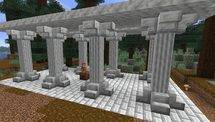
Start with a flat lane about three blocks wide and twelve blocks long. Put solid walls along the sides and mark the finish line with a bright contrasting block. Leave a safe access route beside it so the player can enter and reset the cube without destroying the course. Place the cube at the start and offer a simple block that produces an easily observed movement style.
Your first challenge is merely to reach the finish. Do not add lava, cliffs or pistons. Walk beside the cube, push it gently and watch how it reacts to the walls. If the lane is too long, the first attempt becomes boring rather than instructive. If it is too narrow, accidental collisions become the whole game.
Put a sign at the start explaining the rule: move the cube into the goal without leaving the lane. The clearer the goal, the faster a newcomer understands why the room exists.
Room 2: choose between a bouncy path and a sliding path
Now divide the course into two short routes. One has low bumps and a wide landing area. The other is mostly flat with a gentle turn. Give players access to different absorbable materials and ask them to select the movement style that suits the chosen route.
A cube designed to bounce may feel awkward in a narrow turning corridor. A fast-sliding cube may be difficult to control near an edge. Those differences create the actual puzzle: selecting the right physics behavior rather than simply punching harder. The game becomes more satisfying if every route has a reasonable way to recover.
Test each route at least five times with the same input before telling friends it is balanced. Minecraft is a physical sandbox; subtle terrain and timing differences can change results. A challenge that works once is a demonstration, not yet a finished minigame.
Room 3: a gentle precision gate
Make a short passage where the cube must cross a one-block-wide target zone, but do not make failure mean destroying the cube or falling into lava. Instead, let a missed attempt roll into a return area. This forces players to think about angle and speed while keeping the mood relaxed.
You can introduce a scoring system with signs: one point for crossing the first gate, two for reaching the target, and a bonus for finishing without a reset. Keep the system manual until you are confident the lane is fun. Complicated command blocks and redstone are optional additions, not the foundation of the puzzle.
For a visual finish, use contrasting sulfur and cinnabar blocks from the Chaos Cubed update. Those palettes belong to the same drop and make the minigame look deliberate without demanding rare decorative pieces.
Safety rules: leave explosive tests for a separate arena
The developer explicitly calls out TNT as one of the Sulfur Cube's special interactions. That does not make TNT a wise starting choice for a family survival base. Keep explosive demonstrations in a separate test world or a purpose-built isolated area with clear consent from everyone who shares the world.
A safe course uses solid barriers, predictable materials and no valuable storage nearby. Do not put your main building immediately behind the goal. Even without explosions, a physics experiment can send things somewhere inconvenient. Build a recovery corridor and leave room to retrieve the cube if it ends up in the wrong corner.
If you want to test Magma or other unusual behavior, do so away from vulnerable structures and players first. The novelty will still be there after you protect the world.
How to reset the cube without ruining the game
Use a side door or service walkway to reach the course. If the cube has absorbed a block and you want to reset its behavior, consult the version's shears interaction described by Mojang. The same release notes explain that large Sulfur Cubes can be collected with an empty bucket, which may help you move one between test areas. Check the exact conditions in your edition before building a reset system around them.
A clean reset is part of the level design. If a player misses the finish, they should not spend ten minutes breaking walls and dragging the cube back. Put the reset instructions on a sign and keep a box of spare test materials outside the room.
For multiplayer, let one person act as referee while the others take turns. Otherwise several players may push the cube simultaneously and nobody can tell whether the challenge was solved fairly.
Turn the test room into a three-stage tournament
Arrange the tutorial lane, the choice-of-material route and the precision gate in that order. Give each player two attempts per room and record completion rather than speed at first. Once everyone understands the movement, introduce a timed round with a consistent start signal and the same materials for each participant.
Do not claim a world record unless the course, seed, rules and timing method are actually standardized. A local competition with three friends is fun enough without inventing official rankings. If you record clips, show the full attempt rather than editing out every miss; the failures are often the funniest part of a physics game.
Frequently Asked Questions
Is the Sulfur Cube an experimental feature?
The original Chaos Cubed Sulfur Cube reached stable Minecraft in June 2026. Later variations shown in 26.4 testing may still be experimental.
Does feeding a block change the cube's movement?
Yes. Mojang describes block-dependent archetypes, including bouncy and slippery behavior.
Can you remove the absorbed block?
The Java 26.2 notes describe interacting with shears to remove the block and restore normal cube AI.
Do I need command blocks to build the puzzle?
No. A simple maze with walls, signs, a cube and a clear goal is enough. Commands or redstone are optional refinements.
Should I use TNT for the final room?
It is not necessary. If you experiment with explosive interactions, use a separate safe testing area and avoid risking shared or irreplaceable builds.
Final Thoughts
The Sulfur Cube works best as a puzzle piece when the player can understand what is happening. Start with one mechanic, give it a readable lane, build in an easy reset and only then add tougher goals. A five-minute, funny physics challenge beats a sprawling maze that nobody can finish — especially when your friends are waiting for their turn.
Sources and version notes
Official references used to verify gameplay facts. Player-created build plans and troubleshooting checklists are editorial recommendations, not developer-prescribed missions.